Which is heavier, a BLIMP filled with air or a BLIMP filled with helium?
Learning Objectives
After completing this lesson, the student will be able to diagram and describe the forces on a body moving in a fluid.
Standards
- NGSS HS-ETS1-3
- CCSS.Math.Practice.MP1
- CCSS.Math.Practice.MP2
- CCSS.Math.Practice.MP4
Supplies
- Ellipsoidal BLIMP hull
- Helium
- Scale
- Spring balance
- String
Units Used
- Mass: kilogram (kg)
- Length: meter (m)
- Time: second (s)
- Force: Newton (N) (1 N=1 kg m/s2)
Forces on a BLIMP
Consider your ellipsoidal BLIMP hull. When you inflate that ellipsoidal hull, what do you expect will be the forces acting on it?
The empty hull has a weight. Using your scale, weigh the hull: WB=______ N.
We are going to fill the hull with helium, but that helium has a weight. You can calculate the weight of the helium if you know the volume of the hull. Recall from geometry that the volume of an ellipsoid is (4/3)πabc where a, b, and c are the radii along each axis of the balloon.
- Record the hull’s dimensions:
- a=_______m
- b=_______m
- c=_______m
Hint: if you’re struggling to measure each dimension, consider lining your BLIMP up with a wall or other solid surface to mark off distance against.
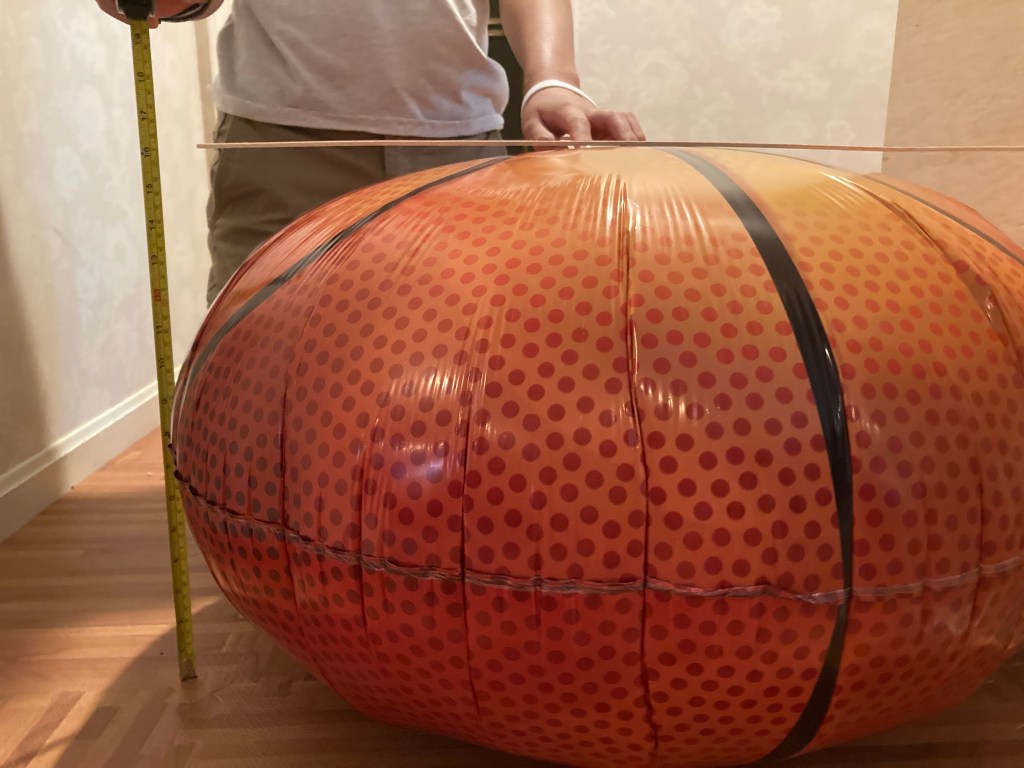
- Then calculate the volume of your ellipsoidal hull:_____ m3
- Lastly, to find the weight of the helium, we need to multiply the volume of the ellipsoidal hull by the density of the helium filling the hull and the acceleration due to gravity. The density of your helium is probably close to 0.18 kg/m3, and the acceleration due to gravity (where you are standing on earth) is 9.81 m/s2. This means, the weight of the helium in your hull WH=_____ N
Archimedes principle tells us that there is an upward buoyant force on a body in a fluid equal to the weight of the fluid that is displaced by the body. Air is a fluid. So, there is a buoyant force on the hull equal to the weight of the air that it displaces. We can find that weight by multiplying the volume that you previously measured by the density of air and the acceleration due to gravity. The density of air varies by temperature, pressure, and humidity; as an approximate value let’s use a density of air of 1.225 kg/m3. The buoyant force acting on your helium hull is B=____ N.
Draw the forces that you’ve calculated on a sketch of the ellipsoid.

The total vertical force on the hull will be the buoyant force, B, minus the weight of the empty hull, WB, minus the weight of the helium in the hull, WH. What do you calculate the total vertical force to be?
B-WB-WH=______N
Let’s do an experiment to see if we are correct. Tie your hull to a spring balance. How many Newtons of force are pulling upward? Does that agree with your calculation?
Next Steps
You are now ready to dive into the lessons on movement. The lesson on density in particular is a nice way to continue this thread of knowledge at an intermediate level, or the lessons on added mass and drag lets you continue this at a more advanced level.


Last updated: November 23, 2022.
 BLIMP
BLIMP 