How do you find a jelly fish’s belly button?
Learning Objectives
After completing this lesson, the student will be able to find centroids for different objects.
Standards
- NGSS HS-ETS1-2
- CCSS.Math.Practice.MP1
- CCSS.Math.Practice.MP4
Supplies
- Ruler
- Balsa wood sheets
- Pins
- Knife (see teacher or parent)
Units Used
- Length: inch (in)
- Length: centimeter (cm)
- Length: meter (m)
Centroids
In geometry, the centroid is the mean position of all points in the shape – this point will be the center of mass if the shape is made of a uniform material. For example, a circle’s centroid is right in the middle of the circle. A rectangle’s centroid is where the line that connects the midpoints of the top and bottom intersects the line that connects the left and right sides. A triangle’s centroid can be similarly found by drawing lines connecting each vertex to the midpoint of the opposite sides.

An experimental way to find a centroid is to find the point where a shape balances on a pin’s point. You can try this with your balsa wood sheets – cut some arbitrary shape and balance it on your pin. You just found the centroid!
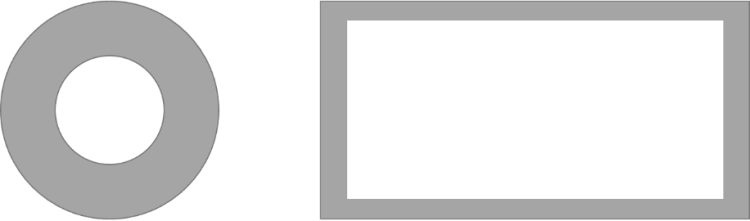
Sometimes the centroid of a shape is not actually on the shape. For example, consider a ring, where is the centroid? Mark the location of the centroid on the following figures:
Next Steps
So how would you find a jelly fish’s belly button? Well, they aren’t mammals, so there is no belly button. But you now know how to find the centroid of any shape! As a next step, apply this to the concepts of center of gravity and center of buoyancy.


Last updated: November 23, 2022.
 BLIMP
BLIMP 