Learning Objectives
After completing this lesson, Functional Flow and System Architecture, and System Performance Characterization and Evaluation, the student will be able to describe the functional flow and architecture of a system and integrate individual components to compose a system. The students will be able to identify test cases to charecterize system behavior and functionality.
Standards
- NGSS HS-ETS1-3
- NGSS HS-ETS1-4
- CCSS.Math.Practice.MP1
- CCSS.Math.Practice.MP2
- CCSS.Math.Practice.MP4
- CCSS.Math.Practice.MP5
Supplies
- BLIMP Kit
- Computer to complete the exercises
Pre-Requisite
- Familiarity with BLIMP building instructions
What is a System?
A system is composed of different elements that are designed to interact with one another to achieve a purpose that cannot be achieved by the elements alone. For example, a commercial aircraft is composed of many parts that are designed to work together to achieve its purpose of transporting goods and people. The body of the aircraft (called fuselage) is designed to provide the structure to hold the engine, wings, fuel tanks, cargo, landing gear etc. While each of these elements provide a specific function (e.g., engine provides thrust), all of these elements work together to safely move and fly the aircraft and its occupants.
Formally, “a system is an arrangement of parts or elements that together exhibit behavior or meaning that the individual constituents do not.” (INCOSE Fellows, 2019)
Let’s examine a few systems in the following figures:
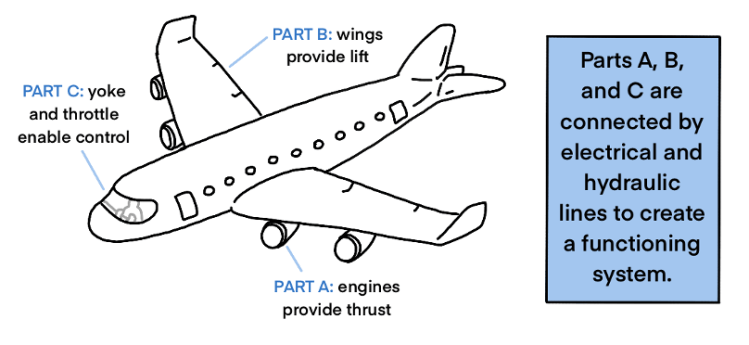
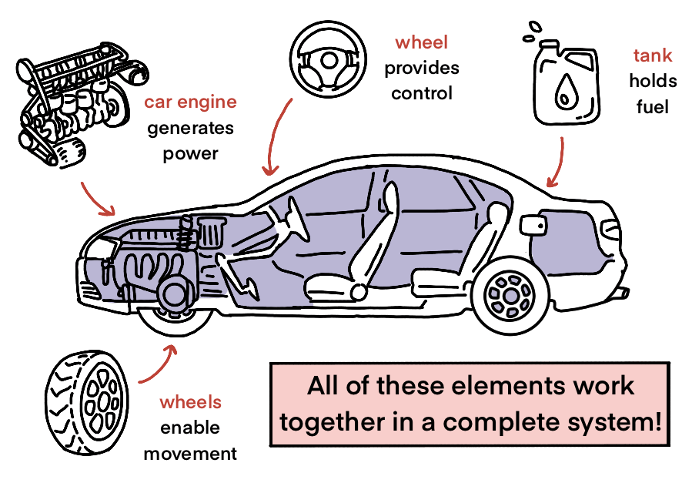
A system has many attributes that help us understand and describe the working of a system. Let’s consider a commercial aircraft as an example of a system to discuss attributes a system. These attributes remain generally applicable to all systems that are engineered to achieve a purpose.
System Attributes:
Purpose: A system always has a purpose for which the different parts and components are brought together. A system must achieve its purpose to justify its existence. For example, the purpose of a commercial aircraft is to safely transport passengers and cargo via air.
Function: Function describes what does a system do to achieve its purpose. A commercial aircraft flies from origin to a destination to safely transport people and cargo. But to fly from origin to destination, the commercial aircraft has to “hold passengers and cargo”, “take-off from origin”, “maintain level flight”, “land at destination” to achieve its purpose.
Structure: Every system has a structure which describes what the system is like. Structure includes the shape and form of a system and identifies the different parts and components of a system. For our commercial aircraft example, the system has a fuselage, wings, control surfaces, engines etc.
Behavior: Behavior of a system describes how the different parts and components (i.e., structure/form) come together with system functions to achieve system’s purpose. For example, wings of the commercial aircraft provide lift while the engines provide the thrust to keep it moving through the air.
Hierarchy: A system can have many different parts and components and grouping them into sub-systems based on their function or structure can help describe their behavior. For example, the engine is one of the many parts of an aircraft, but the engine itself is composed of 100s of other parts such as fuel valves, air intake fans, control units etc. Hence, a system is composed of many sub-systems which in-turn may have their own sub-sub-systems. System hierarchy creates a decomposition of system into sub-system and further sub-systems into sub-sub-systems.
Operational Enviorment: A system performs its functions within an operational enviorment. This operational environment provides inputs to the system and may consume outputs from the system. For example, the operational enviorment of a commercial aircraft may include airports, flying in clam and turbulent weather etc.
System Boundary: The boundary of a system helps distinguish the operational environment of system from its own sub-systems. For example, the boundary of a commercial aircraft includes everything that is within the aircraft and all of its sub-systems but not the airport, runways, or the fuel stations which are part of an operational environment of the system.
Interface: The system interacts with its operational enviorment while its own parts and components interact internally. This interaction involves flow of matter, signals, data, and/or energy that are needed to accomplish system functions. Interfaces enable this flow of matter, signals, and energy. Internal interfaces connect the different sub-systems, parts, and components of a systems, while the external interfaces facilitate flow to and from the operational enviorment.
What system attributes can you identify in the following figure?

Exercises:
- Describe 3 different functions of the BLIMP.
- Develop a system hierarchy of the BLIMP. Identify 3 sub-systems and two parts/components per sub-system. How did you decide on sub-system?
- Identify the internal interfaces between the sub-systems listed in problem 2 above. What flow these interfaces enable (energy, matter, data, or signals)? Why is this flow important?
- Identify an external interface for BLIMP? What flow this interface enables (energy, matter, data, or signals)? Why is this flow important?
Next Steps
Now that you have the basics of systems down, check out Functional Flow and System Architecture.


Last updated: November 22, 2022.
 BLIMP
BLIMP 