How do you decide if your BLIMP is performing well?
Learning Objectives
After completing What is a System?, Functional Flow and System Architecture, and this lesson, the student will be able to describe the functional flow and architecture of a system and integrate individual components to compose a system. The students will be able to identify test cases to charecterize system behavior and functionality.
Standards
- NGSS HS-ETS1-3
- NGSS HS-ETS1-4
- CCSS.Math.Practice.MP1
- CCSS.Math.Practice.MP2
- CCSS.Math.Practice.MP4
- CCSS.Math.Practice.MP5
Supplies
- BLIMP Kit
- Computer to complete the exercises
Pre-Requisite
- Familiarity with BLIMP building instructions
System Performance
System architecture sets the foundations of system performance. Characterizing and evaluating system performance is a multi-faceted activity and is one of the primary jobs of system designers and system engineers.
System performance is directly tied to the system purpose and remains intertwined between systems functions and structure. Each system function can have an individually associated one or more measure of performance (MoP). These MoPs are affected not only by the sub-system which performs the function, but collectively by all other functions and the sub-systems, particularly on functions where there is an input-output dependency. In other words, the system architecture effects the MoP of all functions and hence the MoP of the entire system. Can you think of a few MoPs for a commercial aircraft?
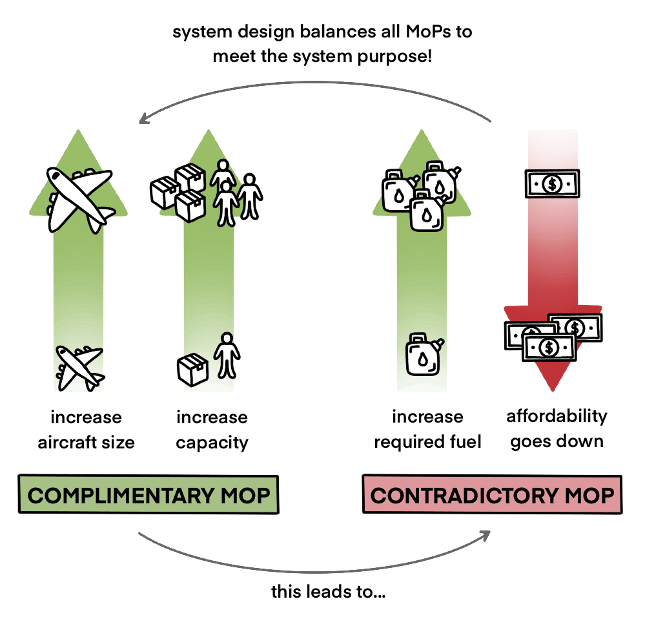
There are two major types of MoPs: complementary MoPs and contradictory MoPs. Complementary MoPs support one another, where increasing one also increases the other. Contradictory MoPs oppose one another where increasing one decreases the other. A system designer has to understand the inter-relationships across all MoPs to balance and optimize the overall system performance. This activity of analyzing system functions’ MoP based on their allocation to sub-systems in a system architecture is called Performance Characterization and Evaluation.
Consider, the top-level system function for commercial aircraft example to provide safe transportation. A MoP for this function can be the cost of transportation which one would prefer to minimize. Now consider the two sub-level functions “1.1 Hold Passengers” and “1.3 Provide Transportation” for instance. An intuitive MoP for these functions can be the number of passengers the aircraft can hold and how far the aircraft can fly to provide transportation, respectively. Ideally, one would like to increase both by carrying more weight and flying more distance, but these MoPs are contradictory given the top-level objective of minimizing the cost.
Exercises:
- Identify 3 MoPs of functions in your BLIMP kit?
- Which pairs of these MoPs are complementary and which pairs are contradictory?
- Consider the sub-system these MoP come from based on the functional allocation (i.e., the system architecture). How are the MoPs affected by the sub-system?
Next Steps
Now that you have a strong understanding of systems, let’s try using simulation to better understand collective behaviors.
Alternatively, this would be a good place to jump toward understanding form and function of engineering systems.


Last updated: November 22, 2022.
 BLIMP
BLIMP 