What is the number one objective of your BLIMP?
Learning Objectives
After completing What is a System?, this lesson, and System Performance Characterization and Evaluation, the student will be able to describe the functional flow and architecture of a system and integrate individual components to compose a system. The students will be able to identify test cases to charecterize system behavior and functionality.
Standards
- NGSS HS-ETS1-3
- NGSS HS-ETS1-4
- CCSS.Math.Practice.MP1
- CCSS.Math.Practice.MP2
- CCSS.Math.Practice.MP4
- CCSS.Math.Practice.MP5
Supplies
- BLIMP Kit
- Computer to complete the exercises
Pre-Requisite
- Familiarity with BLIMP building instructions
Functions and Systems
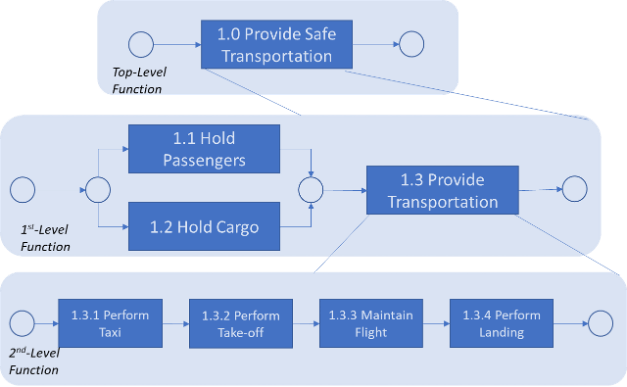
A function is a task or activity performed to obtain a certain outcome. A system performs one or more functions to achieve its purpose. A system has a top-level function which maps to the system purpose and this top-level function is decomposed into several sub-level functions. For example, a commercial aircraft top-level function is to provide safe transportation. This function can be decomposed into multiple sub-functions of “Hold Passengers”, “Hold Cargo”, and “Provide Transportation” etc. These functions can be further decomposed into sub-sub-level functions. For example, in order to provide transportation, the commercial aircraft needs to taxi, take-off, fly, and land. The activity of identifying the system functions and decomposing functions into sub-level functions is called functional decomposition of a system.

A function receives an input (signal, data, energy and/or matter) and transforms the input into an output (signal, data, energy, and/or matter). For example, in order to take-off, the commercial aircraft will need to determine the total weight of the aircraft. This means that “Provide Transportation” needs an output from the “Hold Passengers” (i.e., data) and “Hold Cargo” functions.
A “Functional Flow” diagram illustrates the decomposition and sequencing of functions that a system has to perform. Some functions need to be performed in parallel and some functions needs to be completed before another function can be performed (i.e., when there is an input/output dependency as discussed above). The following figure illustrates a simplified functional flow diagram of a commercial aircraft. Notice how each function is numbered to maintain top-level to 1st level and 2nd level dependency.
System Architecture and Integration: A system architecture describes what sub-systems, part, and/or components, perform which functions and what internal and external interfaces are needed. These interfaces establish the flow of signal, data, energy, and/or matter throughout the system. A system architecture integrates the structure (form) and function into one complete system.
A system architecture is obtained by allocating system functions to subsystems while ensuring there will be necessary flow of signals, data, energy, and matter to satisfy the input and output requirements of functions. For example, a system architecture may allocate the function “1.3.1 Perform Taxi” to aircraft landing gear (wheels and tires) and engines, while the function “1.3.3 Maintain Flight” could be allocated to engine, wings, and fuselage etc.
Side Note: In systems design and systems engineering, the architecture of a system plays a critical role and can take a long time to finalize. The architecture development evolves over many cycles, called iterations, because the structure of sub-systems requires knowledge of functions they will perform.
Exercises:
- Identify the top-level, 1st level, and 2nd level functions of your BLIMP.
- Create a Functional Flow Diagram of your BLIMP.
- Identify which functions are allocated to what components in your BLIMP? (Note: system architecture in your BLIMP kit is carefully pre-designed and remains fixed.)
- Pick 1 internal and 1 external interface and identify the functions and sub-system involved in this interface.
Next Steps
From here, learn how to do System Performance Characterization and Evaluation.


Last updated: November 22, 2022.
 BLIMP
BLIMP 