How do fish avoid becoming dinner?
Learning Objectives
After completing Visualizing Life Histories of Tuna, Stingray, Jellyfish, this lesson, and Predators and Prey, the student will be able to diagram, explain, and compare and contrast life history components of tuna, jellyfish and stingrays as they relate to swimming, feeding and escaping predation.
Standards
- NGSS-HS-PS2
- NGSS-HS-Life Science
- CCSS.Math.Practice.MP3
Supplies
- Helium tank
- 2x party balloons
- 1 long balloon
- 1 round balloon
- 1-2 sheets of construction paper
- Scotch tape
- Scissors
- Pack of air-dry modelling clay
- Worksheet comparing and contrasting life histories and body shapes of tuna, stingray, and jellyfish from Visualizing Life Histories of Tuna, Stingray, Jellyfish
- 2x threads, one for each balloon
Units Used
- Mass: kilogram (kg)
- Length: meter (m)
- Time: second (s)
- Force: Newton (N) (1 N=1 kg m/s2)
Challenge: Create a fish with at least two fins and a tail that can remain neutrally buoyant at rest, and then can ‘swim’ towards a prey item.
Begin by reviewing the worksheet from Visualizing Life Histories of Tuna, Stingray, Jellyfish showing functions and locations of fins and tails. Decide on the number and placement of fins, as well as shape and orientation of tail of your fish.
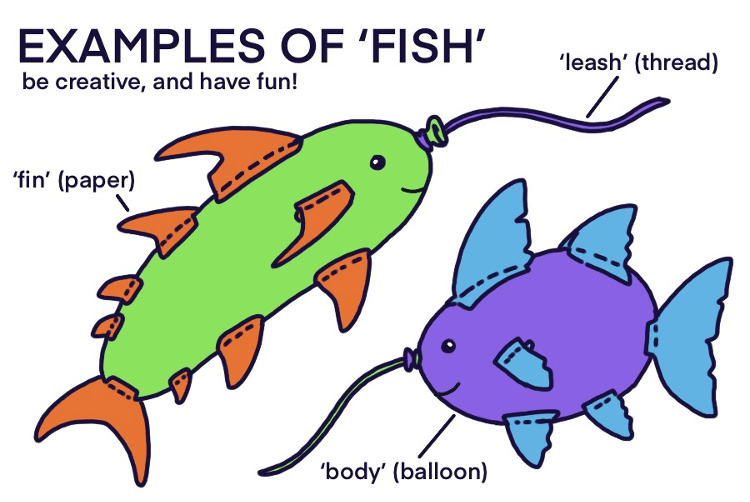
- Select a balloon shape to represent your ‘fish.’ When choosing, consider how the size and shape will influence how the ‘fish’ swims. Inflate your balloon with helium to the point where it can float. It is up to you how big you wish to inflate it, but the balloon wall should be firm enough to attach things to.
- Tie a string around the mouth of your inflated ‘fish’ body that will serve as ‘a leash.’ Secure your balloon such that you can attach fins, so it does not float away.
- Sketch your desired fin shapes and a tail onto construction paper. They can be any shape or size. Keep in mind how the size and placement of your fins will affect the fish’s balance.
- After drawing out your fins, add another sheet of paper underneath (or fold the current one in half) — such that each fin will have two layers for support.
- Cut fins out once ready, and glue or tape the fin pieces together, leaving a bit of space at the bottom. Fold the un-taped parts into flaps and attach them to your fish with tape.
- Double layering should be enough to keep your fins rigid, but if they are still too floppy, consider sizing your fins down or adding another layer of support. Fins should be firm enough to stand up on their own.
- Pay attention to how the fish body’s weight and maneuverability changes as you add the fins. You may want to pull the fish around briefly to test out each fin usage. What happens to your fish when you add one fin? What happens when you add two fins? Does the shape, size, and placement of the fins make a difference?
- Describe what happens when you add on a tail.
- You want your fish to achieve neutral buoyancy, which means it should not sink or rise; it should just ‘float’ and be static at rest. Adjust your fins and tail if necessary. If you need more weight, you may use the putty and tape it to your fish.
- Be mindful of where putty is attached. Consider the center of gravity and center of buoyancy.
Consider the following questions before moving onto the next part.
- Why do balloons rise when filled with helium?
- Air is denser than helium. Archimedes principle tells us that there is an upward buoyant force on a body in a fluid equal to the weight of the fluid that is displaced by the body.
- What are the forces acting on your fish?
- Gravity and buoyancy. When the fish is in movement, lift, thrust and drag also act.
- When will the balloon stop rising?
- When it hits the ceiling or rises to a point where the density of the air outside the balloon equals the density of the helium inside the balloon. When these two densities are equal, there is no longer a buoyant force.
Next Steps
From here, you can use the fish you have built to understand Predators and Prey.


Last updated: November 22, 2022.
 BLIMP
BLIMP 