Learning Objectives
After completing this lesson, the student will be able to diagram and describe the forces on a body moving in a fluid.
Next Generation Science Standards
- NGSS HS-ETS1-3 “Evaluate a solution to a complex real-world problem based on prioritized criteria and trade-offs that account for a range of constraints, including cost, safety, reliability, and aesthetics, as well as possible social, cultural, and environmental impacts”
Common Core State Standards
- CCSS.Math.Practice.MP1 “Make sense of problems and persevere in solving them”
- CCSS.Math.Practice.MP2 “Reason abstractly and quantitatively”
- CCSS.Math.Practice.MP4 “Model with mathematics”
Supplies
- Ellipsoidal BLIMP hull
- Helium
- Putty
- Tape measure
- Stopwatch
- Scale
- Spring balance
- String
Units Used
- Mass: kilogram (kg)
- Length: meter (m)
- Time: second (s)
- Force: Newton (N) (1 N=1 kg m/s2)
Part A: Force Balance
Consider your ellipsoidal BLIMP hull. When you inflate that ellipsoidal hull, what do you expect will be the forces acting on it?
The empty hull has a weight. Using your scale, weigh the hull: WB=______ N.
We are going to fill the hull with helium, but that helium has a weight. You can calculate the weight of the helium if you know the volume of the hull. Recall from geometry that the volume of an ellipsoid is (4/3)πabc where a, b, and c are the radii along each axis of the balloon.
- Record the hull’s dimensions:
- a=_______m
- b=_______m
- c=_______m
Hint: if you’re struggling to measure each dimension, consider lining your BLIMP up with a wall or other solid surface to mark off distance against.
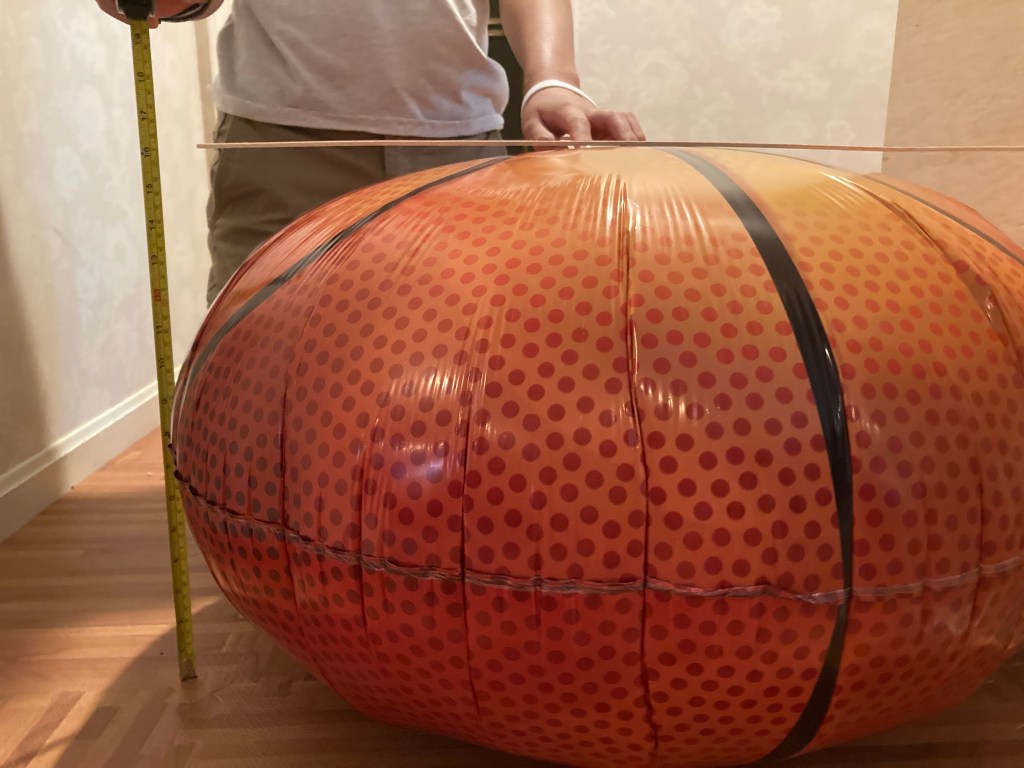
- Then calculate the volume of your ellipsoidal hull:_____ m3
- Lastly, to find the weight of the helium, we need to multiply the volume of the ellipsoidal hull by the density of the helium filling the hull and the acceleration due to gravity. The density of your helium is probably close to 0.18 kg/m3, and the acceleration due to gravity (where you are standing on earth) is 9.81 m/s2. This means, the weight of the helium in your hull WH=_____ N
Archimedes principle tells us that there is an upward buoyant force on a body in a fluid equal to the weight of the fluid that is displaced by the body. Air is a fluid. So, there is a buoyant force on the hull equal to the weight of the air that it displaces. We can find that weight by multiplying the volume that you previously measured by the density of air and the acceleration due to gravity. The density of air varies by temperature, pressure, and humidity; as an approximate value let’s use a density of air of 1.225 kg/m3. The buoyant force acting on your helium hull is B=____ N.
Draw the forces that you’ve calculated on a sketch of the ellipsoid.

The total vertical force on the hull will be the buoyant force, B, minus the weight of the empty hull, WB, minus the weight of the helium in the hull, WH. What do you calculate the total vertical force to be?
B-WB-WH=______N
Let’s do an experiment to see if we are correct. Tie your hull to a spring balance. How many Newtons of force are pulling upward? Does that agree with your calculation?
Part B: Centers
At this point it’s helpful to understand a couple key terms:
- Center of Gravity: The center of gravity is the point about which all weights are evenly spread, so both the magnitude of the weight and the location of the weight matter. On a see-saw for example, a heavier rider close to the center can be balanced by a lighter rider further from the center. For your ellipsoidal hull, where is its center of gravity?
- Center of Buoyancy: The center of buoyancy is the center of mass of the displaced fluid. For an aircraft carrier floating in water, the center of buoyancy is the centroid of the displaced water. In your case, instead of a ship displacing water, you have a helium filled hull displacing air. Where is the centroid of the air displaced by your ellipsoidal hull?
It’s time for an experiment. Put a piece of sticky putty on the side of your hull. What happens? What changed?
Your hull is in equilibrium whenever the weight acting down at the center of gravity, and buoyant force acting up from the center of buoyancy are aligned. Your ellipsoidal hull with putty stuck to it has stable and unstable equilibria. A stable equilibrium will return to that position if perturbed (given a nudge). An unstable equilibrium will transition to the stable equilibrium if perturbed. Can you find stable and unstable equilibria for your hull? Draw the stable and unstable equilibria you’ve found.
Part C: Added Mass and Drag
Newton’s second law can be written as the sum of the forces equals the mass of the system times its acceleration: ΣF=ma. Let’s put this to work here.
- We know all the forces acting on the hull, right? We had found the total vertical force to be ΣF=B-WB-WH=______N directed upwards (that is to say, this is a force vector with magnitude and direction).
- We also know the weight of the helium filled hull; it is the weight of the hull plus the weight of the helium: WB+WH=_____N. The mass of the helium filled hull is then this weight divided by the acceleration due to gravity, 9.81 m/s2. So, the mass m=______kg.
- You know the sum of the forces on the hull, and you know the mass of the hull. Using ΣF=ma, what do you predict the acceleration of the hull to be if you let go of it? apredicted=_____m/s2
(Notice, I am using a subscript of “predicted” here to distinguish this from the acceleration we are going to measure in the next step).
To check our work, we can do an experiment to measure the acceleration of the hull when released between the floor and the ceiling of the room you’re in. (Tie a string to your blimp, or you might need a ladder to fetch the hull – and don’t forget to take that putty off that you stuck on the blimp in Part B!)
The relationship between distance traveled, s, initial velocity, Vo, acceleration, a, and time, t is: s=Vot+1/2at2. If the initial velocity is 0 for something that begins at rest, this simplifies to s=1/2at2. So, to measure a, we need to measure the distance the hull travels and time how long it takes to make its journey.
- What is the distance from the floor of the room you are in to the ceiling? D=_____ m
- Subtract from that twice the radius of the hull, r (r=a, b, or c depending on which orientation you want to release your ellipsoid in). We’re going to measure the acceleration of the hull from the floor to the ceiling, but the center of the hull is moving from one hull radius above the floor, to one hull radius below the ceiling: s=D-2r=_____ m
- Now let’s time how long it takes the hull to rise from the floor to the ceiling. Make sure the hull is starting from a stand still. Repeat that a few times until you are confident in your time measurement. t=____ s
What then was the hull’s acceleration a=2s/t2? ameasured=____ m/s2
Does this agree with what you were expecting with apredicted?
I venture to guess that your measured and predicted values are close, but not exactly in agreement. Part of this may come from your measurement of distance or timing. But part of it is also due to both drag and added mass. Drag opposes the direction of motion for a body moving in a fluid, and is proportional to velocity squared. Added mass comes about because a body accelerating through a fluid has to accelerate the fluid it is displacing. This effect is often negligibly small on vehicles like airplanes, but we can in fact see its effect with your ellipsoidal hull! If you’re interested in doing a controlled experiment to measure drag and added mass, check out: http://salt.uaa.alaska.edu/jim/mass.pdf.
Bonus: Venus
With a very dense atmosphere, Venus is hot. Really, hot, making it difficult for exploration by rover. But, it is explorable by balloon! In 1985, Russia deployed two helium balloons on the Vega 1 and Vega 2 missions in order to study Venus. A recent paper by Hein, Lingam, Eubanks, Hibberd, Fries, and Blase in Astrophysical Journal Letters outlines a balloon mission to Venus that could be used to detect signs of life. You can check it out at: https://iopscience.iop.org/article/10.3847/2041-8213/abc347/meta . What would change for the buoyant and gravitational forces acting on a balloon on Venus? How would added mass be affected?
Last updated June 1, 2022.
 BLIMP
BLIMP 